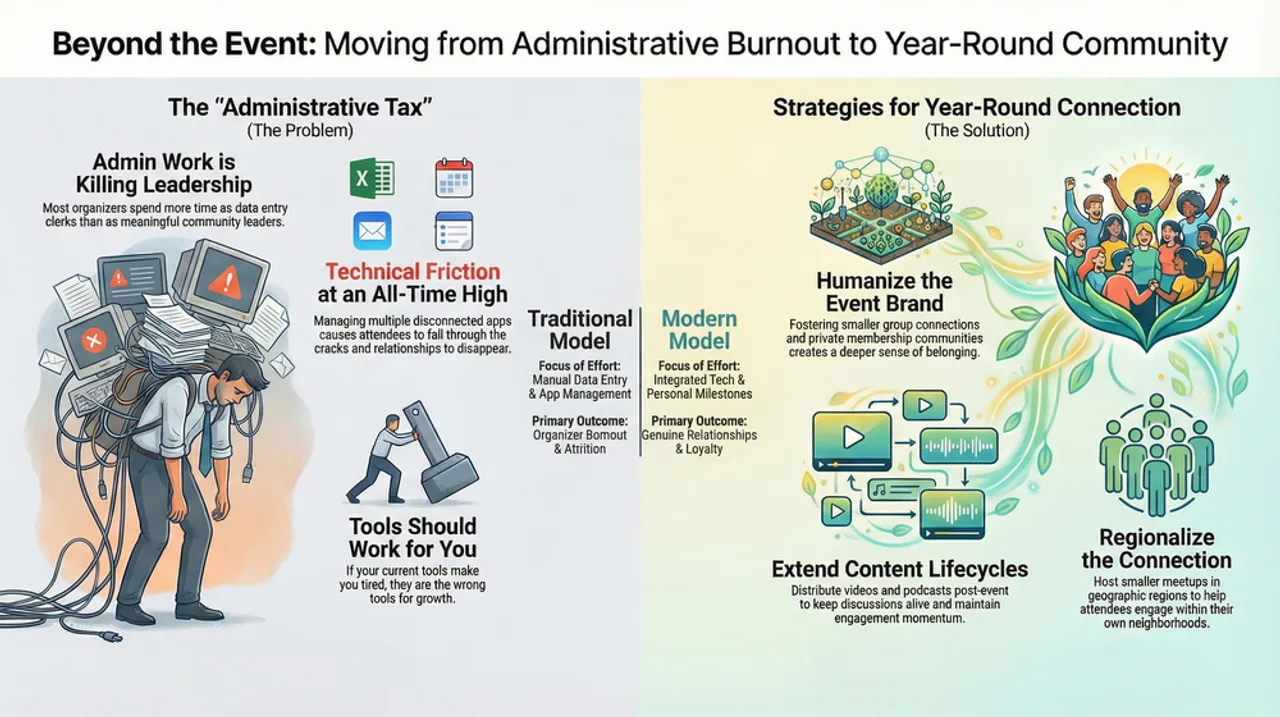
Most community organizers spend more time as data entry clerks than as leaders. It is the hidden tax of the industry that nobody talks about. You spend your day copy-pasting email addresses from a registration list into a spreadsheet and then into another email tool. By the time you actually get to talk to your community you are too tired to say anything meaningful. This is exactly how burnout starts and it is killing the passion in our industry.
The technical friction of running a community is at an all-time high. When you have to manage five different apps just to host one event things are going to break. People fall through the cracks and relationships that should have lasted for years end up disappearing after a single weekend. We are essentially building houses on sand and wondering why they don't stay standing.
We need to fix the chores that eat our time.
When we fix these friction points we give ourselves room to breathe. The goal is to get to a place where the tools work for us instead of us working for the tools. We should be building connections not just managing lists.
If your tools are making you tired they are the wrong tools.
"Theater promotes deviant behavior."
That is what Mohamed Amin was told when he tried to bring storytelling to the Muslim community. He didn't just face skepticism; he faced total rejection.
As the founder of Lantern Islamic Theater, Mohamed is fighting a cultural battle to prove that the arts aren't just compatible with faith—they are essential for it. In this episode, he reveals the brutal reality of being a pioneer: from holding auditions where zero people showed up, to the toll on his mental health, and why he believes the "money-hungry" mindset of some institutions is stifling the next generation of creators.
If you’ve ever been told your passion doesn't fit the mold, this conversation is for you.
Timestamps:
0:00 - The stigma: Why theater makes people uncomfortable
5:26 - "Deviant behavior": The harsh reality of pushback
15:38 - The day nobody showed up (0 attendees)
19:50 - Why non-profits are taken more seriously than businesses
39:17 - The mental health cost of being a first-mover
Join our Community on Thigmo to watch ad-free: https://thigmos.com/rise
Subscribe to the RISE video podcast on YouTube: https://www.youtube.com/playlist?list=PLjERW90HeGxg38Zu4nHMDgRO6uA7oxE_I
Listen on Spotify: https://creators.spotify.com/pod/show/29fkNoTM6RPFLuVK2UuqFZ/episodes
Why do some events sell out instantly while others struggle to get 10 sign-ups? Camille Mejia launched a pickleball social club in 2024, and her speed-dating tournaments now sell out in under 15 minutes.
In this episode, she breaks down:
If you’ve ever thought about starting a club, hosting meetups, or turning your passion into a community, this is the playbook.
Want to build your own tribe?
Join our community of founders and creators on Thigmo: https://thigmos.com/rise
Watch more episodes of RISE: https://www.youtube.com/playlist?list=PLjERW90HeGxg38Zu4nHMDgRO6uA7oxE_I
#CommunityBuilding #SocialClub #Pickleball #TikTokMarketing #BrandPartnerships #EventPlanning #Startup #Entrepreneur
By now, you can see how much I am invested in community building and bringing people together through events. And the people I would personally serve the most are community builders and event organizers because they took upon themselves to bring people together.
The event industry is hitting a wall right now. We are all pretending that things are back to normal but the reality is that most organizers are running on fumes. The demand for people to get together is higher than ever but the money and the help to make it happen have basically vanished. We are stuck in a cycle where we are expected to pull off miracles with half the budget and a fraction of the team we had five years ago.
The old way of just throwing a big party and hoping for the best is dead. Today if you cannot prove exactly why an event was worth the money you are probably going to lose your budget next year. It is a stressful time to be a builder because the stakes have never been higher while the support has never been lower. We have to stop treating events like one-off projects and start looking at the bigger picture of how we keep people together.
I have spent a lot of time lately looking at why some groups are thriving while others are falling apart. The ones winning are not the ones with the biggest venues. They are the ones who have stopped trying to do everything manually and started focusing on deep engagement. We need a way to make the technical side of this job invisible so we can get back to the actual work of connecting people.
This year has been a big learning experience for me. Not the kind you read about in books, but the kind you only learn by getting things wrong and fixing them.
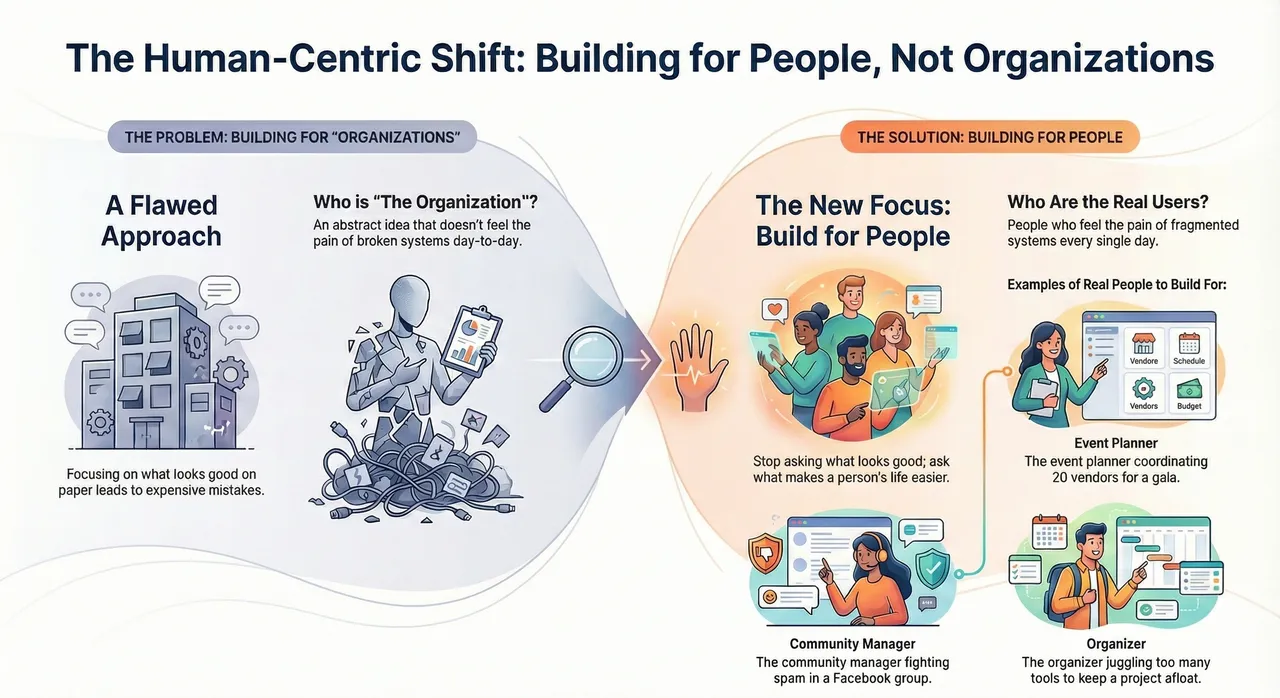
One of the biggest lessons was realizing that we shouldn’t be building for “organizations” as an idea. We should be building for the people doing the actual work.
The person staying up late trying to coordinate 20 vendors for a gala.
The community manager working hard to keep a Facebook group from turning into a spam mess.
The organizer juggling too many tools just to keep things from falling apart.
These are the people who really feel the pain of broken and fragmented systems. Not in theory, but every single day.
Once we started thinking this way, a lot changed. We stopped asking what looks good on paper and started asking what actually makes someone’s life easier.
I’m still learning. Still making mistakes. But this shift has been one of the most important ones.
Curious to hear from you.
What’s the hardest part of the project you’re working on right now?